Address each customer in their own language
Offer the same tour in different languages without having to rebuild it from scratch each time. Customers receive clear information in their preferred language, and your team can more easily find a suitable guide.
Run the same tour only once
In practice, Dutch-, French-, and English-language versions of the same city walking tour are all part of the same tour.
They have the same duration, price, capacity, starting location, and availability. The only difference is the language in which you present and guide them.
That's why, in Eguide, you don't have to create a completely new tour for every language. You manage the tour once and add the necessary translations.
If the price, duration, or meeting place changes, update it in only one place. This will prevent different language versions from displaying different information over time.
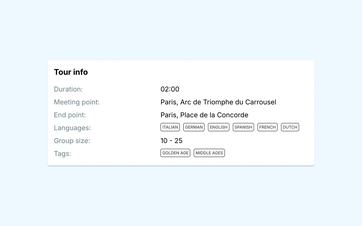
Help customers understand your offer before they book
A customer doesn't just want to read the title of a guided tour in their own language.
He also wants to understand what he'll be experiencing, what's included, where the activity starts, and what he needs to prepare for.
That's why you can translate the customer-facing information in your offering. Each language receives a complete explanation, while you continue to use the same tour internally.
This reduces uncertainty during the booking process and minimizes practical questions afterward.
To learn how customers view and book your offerings, see the section on booking tours and activities online.
Choose which languages you want to offer
You don't have to make your entire product lineup available in every language right away.
You choose which languages suit your business and add the translations when you're ready to serve customers in those languages.
That way, you can start with the languages you work with most often today and expand your offerings later.
See how a single guided tour works in multiple languages
We follow the same tour process, from the initial offer through booking to the guide.
Continue to communicate in the customer's language
Language selection doesn't end once the booking is made.
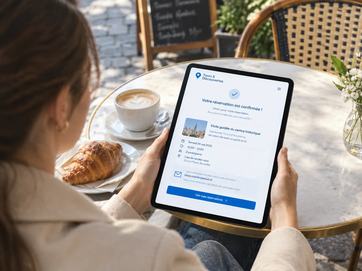
A customer who makes a reservation in French also expects to receive a confirmation in French and clear follow-up information. They don’t want to suddenly receive messages in Dutch or an incomprehensible description on a document.
That is why the customer's preferred language continues to be used in all further communication.
Your team doesn't have to remember which language to use for every message. The appropriate version of your prepared message can be used automatically.
You can learn how to create these types of recurring messages in the section on reusable email templates for your customer communications.
Be sure to give proposals and documents a distinctive description as well
The customer-friendly name of the tour may reappear when the customer comes across the offer later.
This ensures that the same recognizable name is used consistently in communications and documents related to the booking.
As a result, the customer doesn't have to guess whether the Dutch internal name refers to the same activity that they previously selected in French or English.
Find a guide who speaks the language for each group
Multilingual operations are not just about text.
Ultimately, the group must be guided by someone who has a sufficient command of the requested language and is familiar with the tour route.
That's why the language remains linked to the group within the booking. Your team will then see which guides are eligible for that combination.
You can specify which languages and tours a guide can lead using the overview of languages and tour expertise for each guide.
From there, you'll move on to finding a suitable guide for that specific group.
Combine different languages within the same booking
Even a single booking can consist of groups that speak different languages.
For example, a company can host both a Dutch-speaking and a French-speaking group at the same time. Each group is then assigned its own language and a guide suited to that language, while remaining part of the same booking.
This way, your team can maintain a single overview for the customer without having to address all groups in the same language.
Keep control over your wording
Eguide stores and uses the translations that your organization adds.
So you get to decide for yourself how to describe a tour and which words best suit your brand, audience, and region.
No texts are published automatically without being reviewed. This ensures that communication remains natural and recognizable in every language.
Frequently Asked Questions About Multilingual Work
Practical answers about offerings, customers, and guides.
No. You manage the same tour once. The price, duration, capacity, and schedule remain shared, while you add the necessary language versions for customers.
You can translate the customer-facing content, such as the title, description, included items, and practical preparation instructions.
This way, the customer sees more than just a translated name.
Yes. The customer's preferred language can be used for email templates and other supported customer communications.
Your organization must provide the correct language versions in advance.
Yes. Within a single booking, you can Select one or more languages per group. This is subject to the set limit and the languages you have configured as available in Eguide. When searching for a suitable guide, Eguide takes into account the selected language or languages of each group.
Yes. For each guide, you can specify which languages they speak and which tours they can lead. This information helps the dispatch team to qualified candidates to compare across a group.
No. Your organization adds the desired translations itself. This allows you to maintain control over the quality, tone, and accuracy of each language version.
Can't find your question here? Please contact us. We'd be happy to help you figure out how to organize guided tours in different languages today.