See right away what's been confirmed — and what hasn't
Track customer approval, payment, operational validation, and guide assignment separately. This way, your team will know which steps have been completed and where a decision or action is still needed.
Payment does not automatically mean confirmation
A customer completes the online payment. The payment has been received, and the reservation is now in Eguide.
However, your team may still need to check whether the date, group assignments, locations, and logistical arrangements are feasible. You may also still need to find the right guides.
When payment and confirmation are treated as a single step, the booking appears to be final to the customer even though your organization has not yet verified the details.
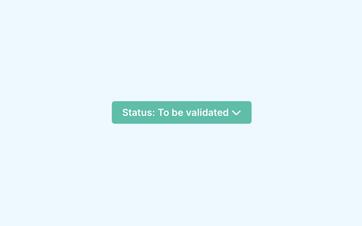
Eguide therefore keeps these steps separate. After a successful online payment, the booking is assigned the status “Pending Validation.” The payment has been recorded, but a staff member still makes a deliberate decision as to when the appointment can be confirmed.
This makes it clear what each status means: the payment status indicates the amount, the booking status indicates operational approval, and the guide status indicates group occupancy.
Make validation a conscious decision-making moment
Validation is the moment when your team confirms that a booking can proceed according to standard operating procedures.
An employee reviews the information relevant to the booking and validates it once everything has been thoroughly checked. Only then is the final booking confirmation sent to the customer.
Your team can view all relevant information in the complete booking file, which brings together customer data, groups, scheduling, and financial tracking.
Acknowledge receipt without making any promises too soon
In the meantime, customers don't have to remain in the dark. After submitting an online request or making a payment, they first receive a message confirming that everything has been received.
That confirmation of receipt or payment is not the same as the final booking confirmation. It informs the customer that the request is being processed, without prejudging an operational review that still needs to take place.
This way, both communication steps have a clear purpose: first, you confirm receipt, and then you confirm that the booking can actually go ahead.
See how each status has its own meaning
We track each booking from customer approval through to confirmed completion.
Keep the guide schedule separate from the client appointment
The scheduling of guides doesn't always proceed at the same pace as the rest of the booking.
You can confirm a booking even if one or more guide requests are still pending. Conversely, a guide does not confirm the booking by accepting an assignment.
That distinction prevents a single response from altering the meaning of the entire file. The client appointment may have been approved from an operational standpoint, even though your team is still finalizing the group assignments.
To continue with your planning, you can submit guide requests, follow up on responses, and find a replacement if a request is denied.
Replace a guide without canceling the reservation
If a guide declines after the booking has already been confirmed, the appointment with the customer remains in effect. Only the guide assignment needs to be addressed again.
So you don't have to cancel or rebuild the booking just because one part of the schedule changes.
The individual statuses show exactly where the problem lies: not with the client approval or the operational approval, but with the still-pending guide schedule.
Reopen a booking when the appointment changes
Even a confirmed booking can still undergo significant changes later on. For example, the customer might add an extra group, choose a different time, or want to start at a new location.
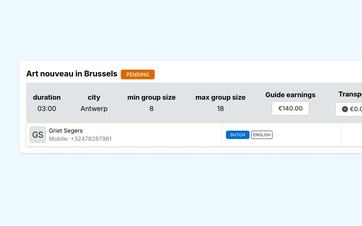
In such a situation, an authorized employee can change the booking back to "Pending Approval" directly. It does not need to be canceled first or created as a new record.
The booking will remain in place, but your team will receive another clear reminder that the revised appointment needs to be reviewed.
The payment status retains its own meaning in this context. A received amount does not disappear simply because the operational agreements are being reviewed. You can continue to track the payment and any outstanding balance separately.
Encourage every colleague to ask the right follow-up question
Because the various phases are not combined into a single general status, each colleague can see what is relevant to his or her work.
Sales can check whether the customer has accepted a proposal. Operations can check whether the booking has already been verified. Planning can check whether all guides have been confirmed. Finance can check whether the amount has been received or is still outstanding.
An accepted proposal is then processed into a booking, but that booking is reassigned the status "Pending Validation." You can read more about this in the section on processing and tracking proposals before they become bookings.
This way, everyone works from the same file, without any single event distorting the rest of the follow-up.
Frequently Asked Questions About Booking Statuses and Validation
Practical answers about your succession.
At that point, the proposal becomes a Booking to be validated.
Acceptance constitutes the customer's agreement. Operational confirmation will not be issued until an employee has reviewed and validated the reservation.
Yes. Operational validation and Guide Scheduling are monitored separately.
A booking can therefore already be confirmed even while one or more guide requests are still pending.
No. Acceptance only changes the Guide Assignment Status.
The booking itself is validated separately by an authorized employee.
Dispatch sees the refusal and can then Select a different guide and post it. If the entry had already been validated, it remains validated.
Yes. If changes to arrangements require another operational review, an authorized employee can revert the booking directly to To be validated.
You don't need to cancel the reservation first.
Can't find your question here? Please contact us. We'd be happy to help you figure out how to organize confirmation and validation within your organization.