Give tour guides one place for everything they need for their work
Responding to new requests, preparing for future assignments, and maintaining personal information: each guide works from their own secure environment, without access to your central management system.
Let the guides start with what needs attention today
A tour guide doesn't want to have to search through old emails first to find out if there's a new request waiting or where the next tour starts.
In the Guide Portal, each guide can view a personalized overview of new requests, today's assignments, and future bookings.
This makes it immediately clear which ones still require a response and which assignments have already been confirmed.
Dispatch doesn't have to resend that information every time. Whatever is scheduled in Eguide also appears in the relevant guide's personal workspace.
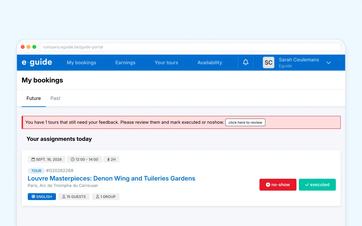
Let guides respond to new requests themselves
When Dispatch contacts a guide for a group, the request appears in the Guide Portal.
The guide can see which tour it is, when it takes place, and which group needs guidance. He can then accept or decline the assignment.
The response is sent directly to the booking. This means your team no longer has to manually enter a response from an email, message, or phone call.
To learn how Dispatch selects candidates and proceeds after a rejection, see the section on submitting and replacing guide requests.
Keep old assignments available without causing confusion
Previous assignments and rejected applications also remain available for the guide to review.
The buttons that are only needed during active follow-up disappear as soon as a task is complete. This allows the guide to still view the history without accidentally responding to an old request again.
View the workplace from a guide's perspective
We'll walk you through the application process, a future assignment, and the practical preparations.
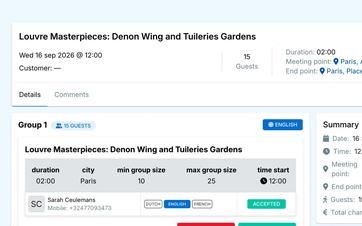
Provide the necessary practical information for each assignment
Once accepted, the assignment remains available in the guide's personal schedule.
From the details, he can see, among other things, the date, time, duration, number of participants, language, and the agreed-upon start and end locations.
The relevant customer and group information is also linked to the assignment. This way, the dispatch team doesn't have to create a separate briefing for every booking with information that's already available in Eguide.
If something important changes later, the guide will receive a notification and can reopen the updated assignment.
Make sure questions are directed to the right reservation
If a guide has a practical question or would like to share an update, they can leave a comment on the booking.
That note also appears for the internal team. This ensures that everyone is working from the same context and doesn't have to link the question to the correct entry again.
When adding comments, you decide which information is intended only for the team and which can also be shared with guides. You can read more about this in the section on saving comments and communication in the appropriate file.
Determine whether guides are allowed to see prices
Your organization can configure whether amounts and prices are visible in the Guide Portal. This allows a guide to receive the operational information for the assignment without automatically gaining access to financial details.
Let guides keep their personal information up to date themselves
You do not need to first notify a staff member via email of a change in your phone number or account number.
In the Guide Portal, a guide can view and update their supported personal and administrative information. This may include contact information, address details, and financial information, among other things.
The information that a guide is allowed to manage on their own depends on your organization's settings. Information such as authorized work areas and formal tour qualifications may remain under the control of dispatch.
The central profile remains available in the directory managed by your internal team.
Give guides access to their own reports
A change to an order does not have to be recorded only in the central booking system.
The Guide Portal includes a personalized notification feed that displays changes to the schedule or assignment. From the notification, the guide can immediately open the relevant booking.
This makes it clear what information is new, without requiring a separate phone call for every change.
Keep scheduling and availability in the same environment
In addition to assignments, the personal workspace can also be used to track availability and view confirmed bookings in a calendar.
This allows the guide to indicate, from within the same interface, when he usually works and where exceptions apply.
Because availability management has its own workflow, it is handled separately when managing work hours, exceptions, and calendars.
Do not close the task until it has actually taken place
On the day of the tour, a guide can, if the assignment qualifies, record whether it was completed or whether the customer did not show up.
That step is separate from the earlier acceptance of the request. First, the guide accepts the assignment; only after it is completed is a record made of what actually happened.
You can read more about this in the section on recording work performance and attendance.
Frequently Asked Questions About the Guide Portal
Practical answers about the personal guide environment.
The guide can see new requests that still need a response, assignments for today, future bookings, and past assignments.
The information displayed is limited to your own assignments and personal information
When a new application is submitted, the guide receives a email and a report in the Guide Portal.
There, the guide can view the assignment and either accept or decline it. The response will then appear next to the relevant booking for dispatch.
The guide displays relevant practical information, such as date, time, tour type, duration, language, group size, and locations. Additional customer, participant, and group information may also be available for the assignment.
Yes. A guide can add a practical question or update to an assignment. The comment also appears for authorized employees in the central management environment.
Yes, for the fields for which your organization allows self-management.
Certain information, such as formal qualifications or authorized work areas, may remain under the control of dispatch.
No. The Guide Portal is the personal workspace for guides and other relevant staff members. It is not a customer portal and does not give customers access to bookings or internal information.
Can't find your question here? Please contact us. We'd be happy to determine what information and actions your guides need in their personal accounts.